Back
Back
WOON — Web3 name card platform
Brand, strategy, and pitch deck, written on personal initiative. Funded by ApeCoin DAO and built.
Role
Brand & Strategy
Industry
Web3 · Identity
status
Funded
Year
2023
Challenge
The paper business card is one of the few professional objects that hasn't changed in a century. It's expensive to print, out of date the moment a job changes, and thrown away by most people who accept one.
Digital replacements exist and mostly haven't stuck, because they solve the wrong half of the problem. Sharing contact details was never the hard part — verifying them is. A card can claim any title at any company and nobody checks.
Nobody commissioned this. The proposal had to create its own reason to exist, then convince a DAO — a voting body of token holders, not a client — to fund it.
Process
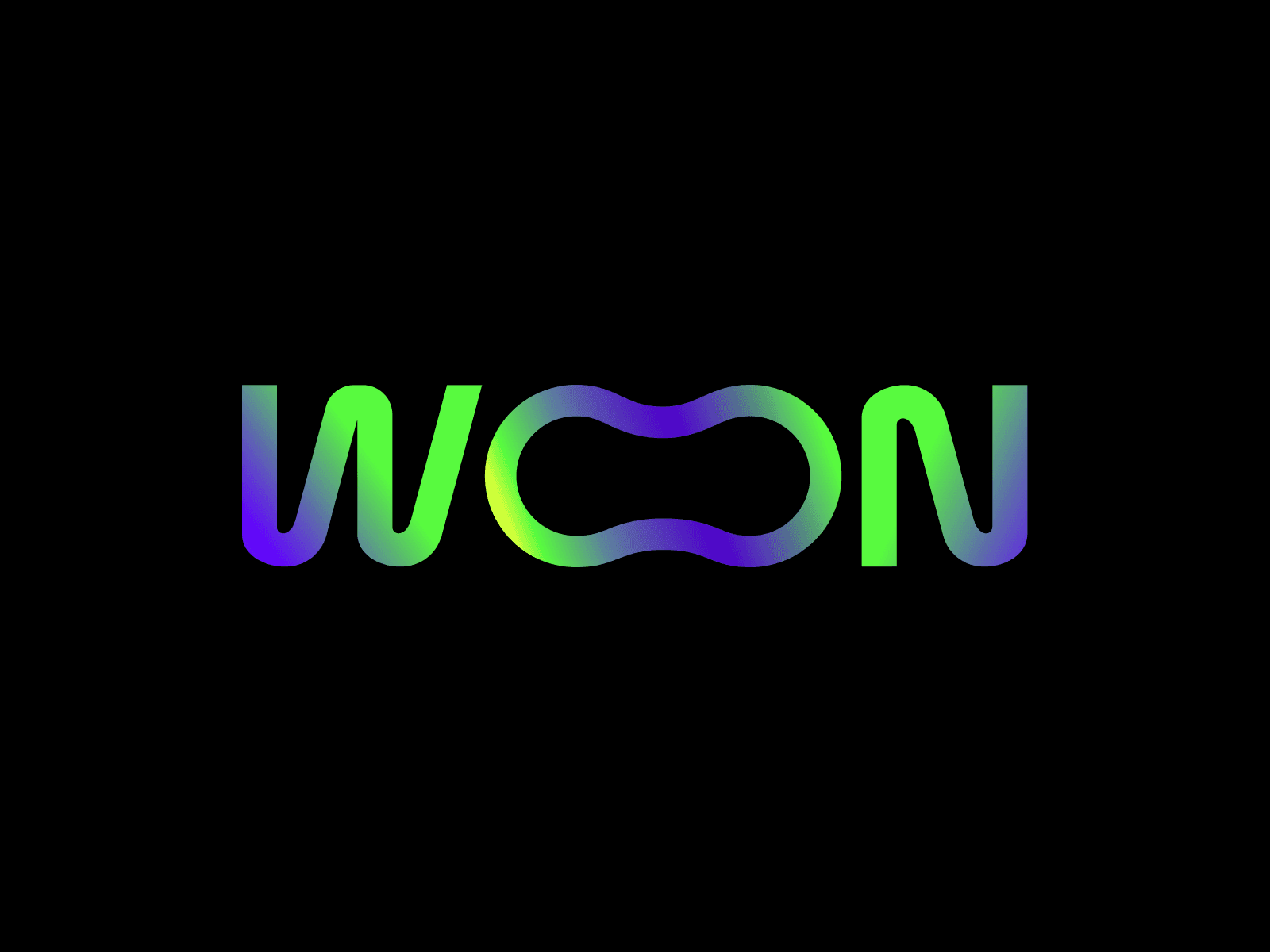
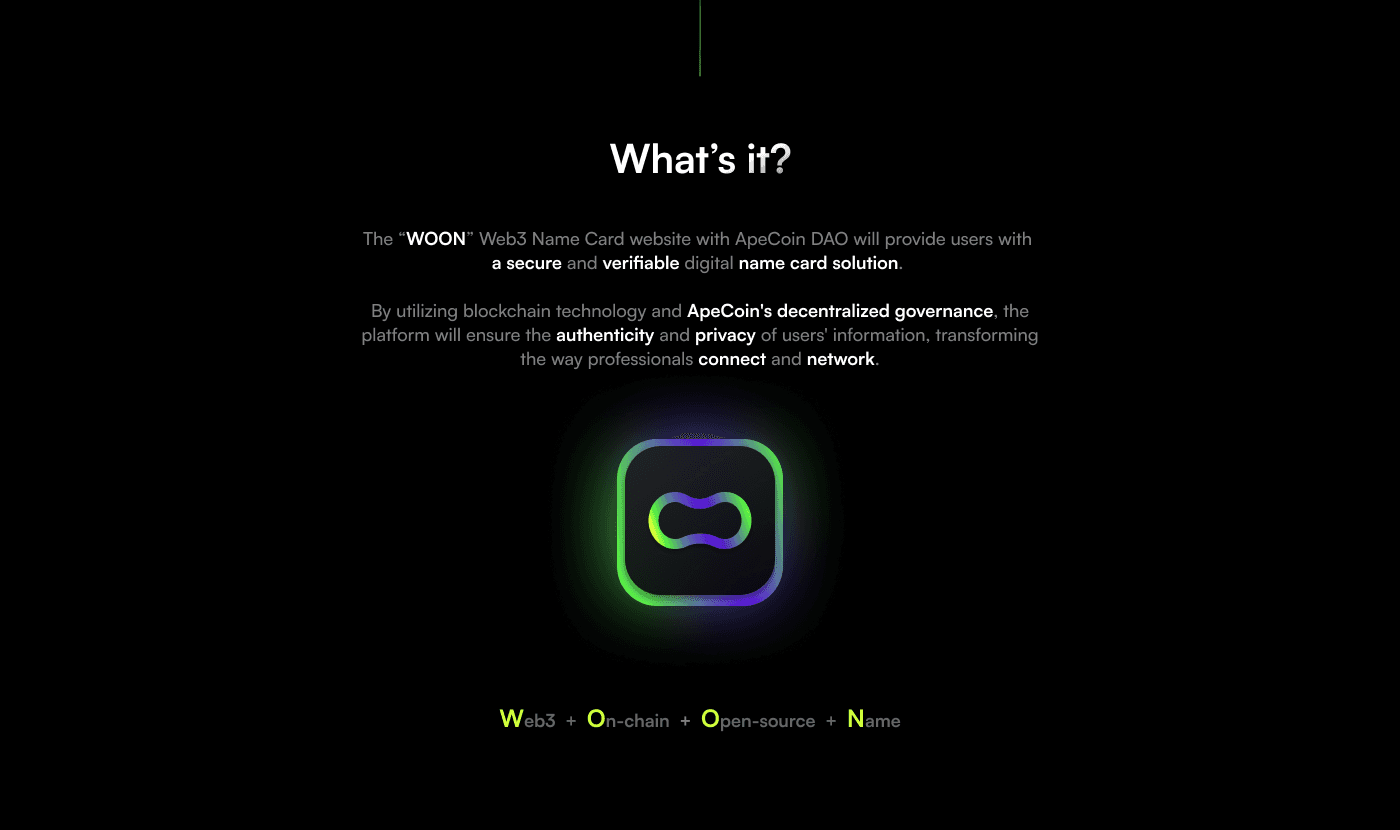
The mark is one idea working at two scales. The wordmark fuses the double-O into a single continuous form: two circles merged into one shape that reads simultaneously as connection, as two profiles meeting, and as an infinity loop. Isolated, that same form becomes the app icon. Mark and icon aren't two assets drawn to match — they're one drawing at different crops, which is what makes the identity hold together across a wordmark, an avatar, and a favicon.
The name is the argument, revealed late. WOON is a backronym — Web3 + On-chain + Open-source + Name — and the deck holds that until after the concept has landed. It reads as a name first and explains itself second, rather than announcing its own cleverness on the cover.
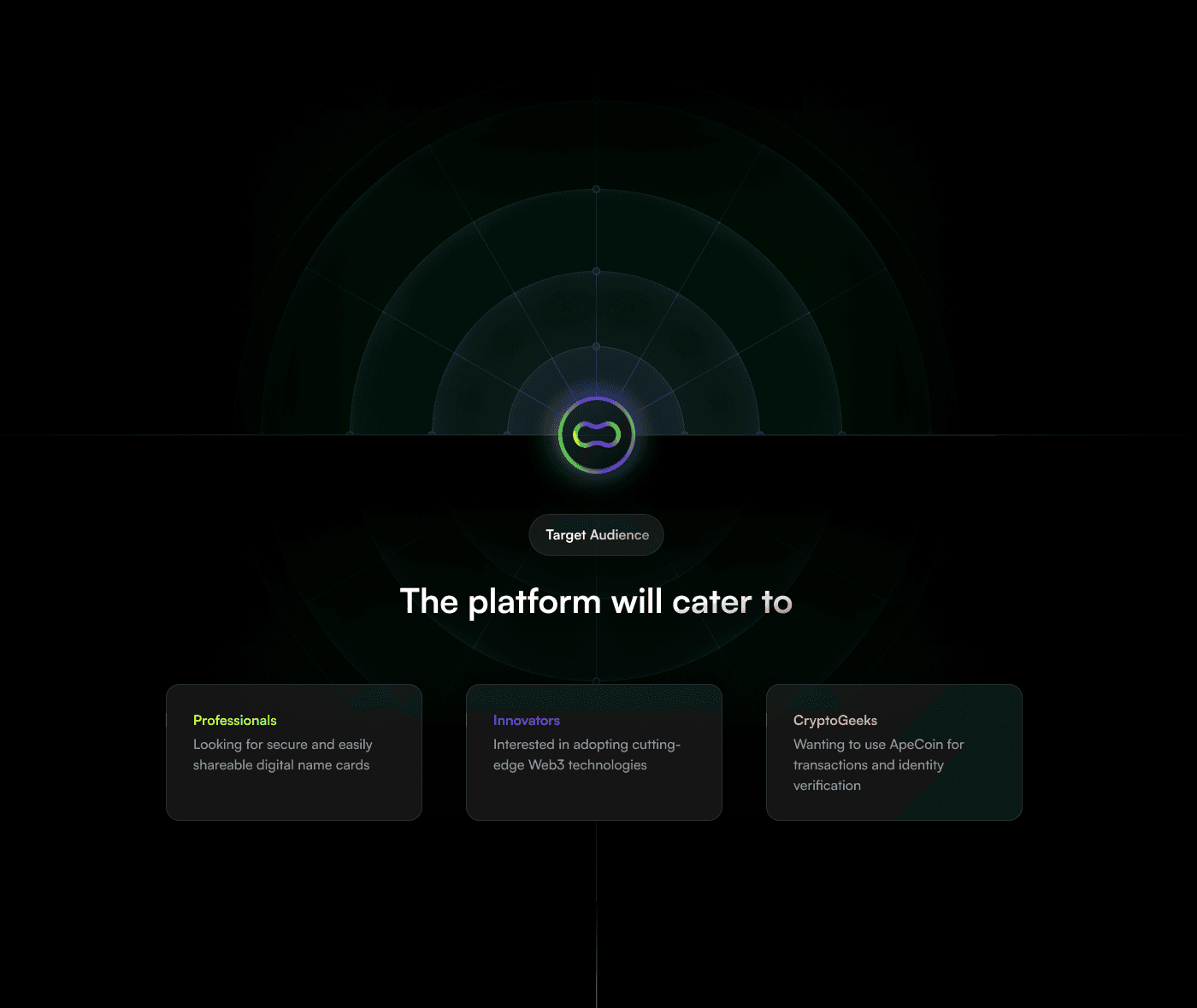
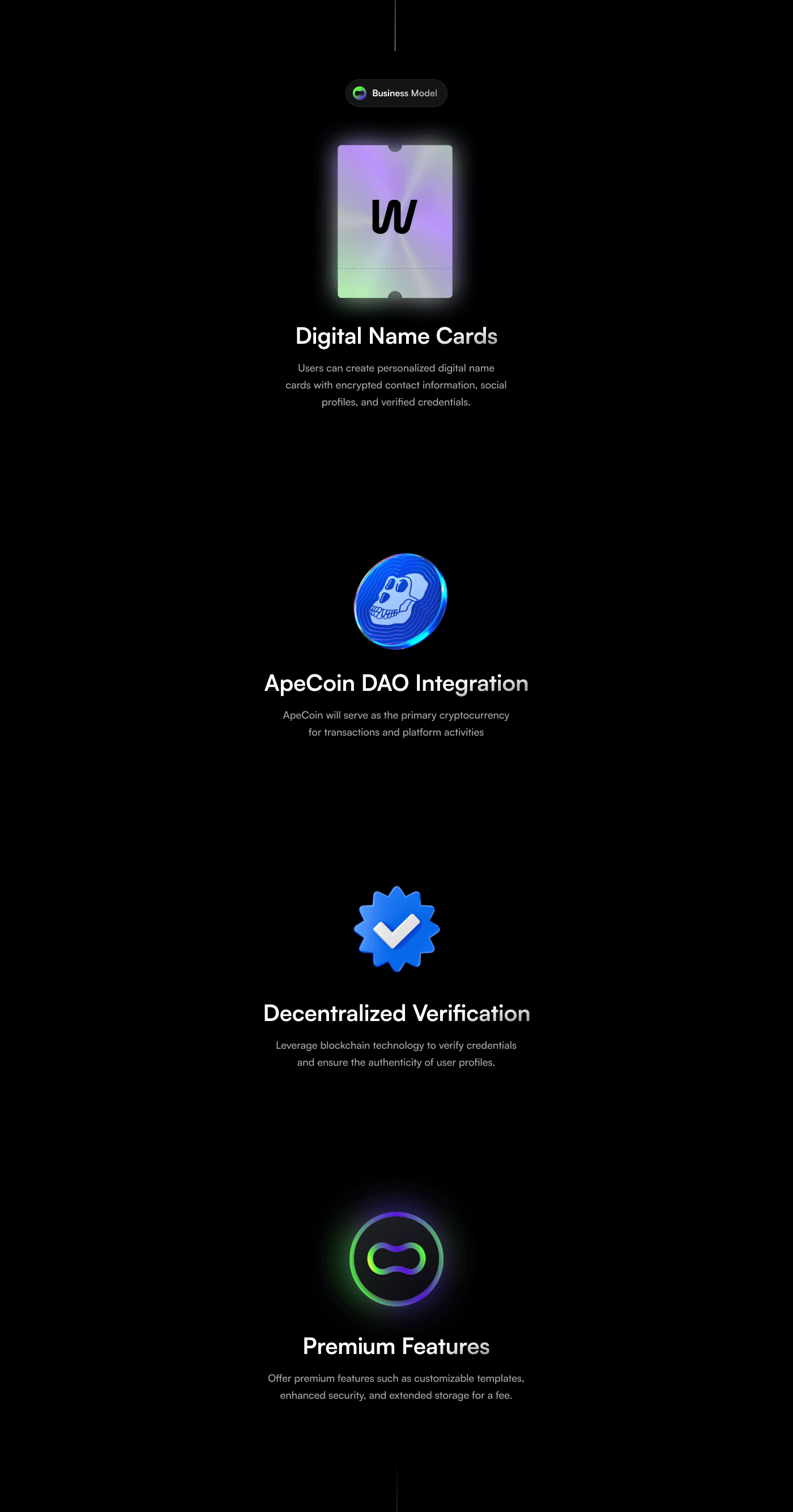
Three audiences, not one persona. Professionals who want a shareable card, innovators adopting Web3, and ApeCoin holders looking for token utility. Segmenting that way meant the pitch could argue three different reasons to care instead of assuming everyone wanted the same thing — and it's why the revenue model runs four directions: the cards, ApeCoin transaction integration, verification, and premium tiers.
The unglamorous arguments carry weight. Alongside decentralized control and tamper-proof credentials, the market case argues that digital cards are cheaper than printing and don't waste paper. Not the exciting claims, but the ones a sceptical reader can't dispute.


Outcome
Written and pitched on personal initiative — no client, no brief, no invitation. ApeCoin DAO funded it, and the platform was built.
My scope ended at the proposal: brand identity, product concept, business strategy, copy, and the deck. The build was someone else's.
What I Learned
The audience sets the bar, not the idea. This deck argues almost entirely from assertion — six reasons it's a good fit, no market sizing, no competitors, no numbers. A corporate partnerships team would have rejected it on the first read. A DAO funded it. I wrote a proposal to Riot the same year that was far more rigorous and heard nothing back, and the difference wasn't quality of thinking — it was who was reading and what they needed to see.
Drawing the mark and the icon as one form instead of two saved the identity. Every scale problem I'd normally solve with a separate lockup solved itself.
Writing the pitch nobody asked for is the cheapest way to find out if an idea holds. It cost a deck, and it returned funding.
Back
WOON — Web3 name card platform
Brand, strategy, and pitch deck, written on personal initiative. Funded by ApeCoin DAO and built.
Role
Brand & Strategy
Industry
Web3 · Identity
status
Funded
Year
2023
Challenge
The paper business card is one of the few professional objects that hasn't changed in a century. It's expensive to print, out of date the moment a job changes, and thrown away by most people who accept one.
Digital replacements exist and mostly haven't stuck, because they solve the wrong half of the problem. Sharing contact details was never the hard part — verifying them is. A card can claim any title at any company and nobody checks.
Nobody commissioned this. The proposal had to create its own reason to exist, then convince a DAO — a voting body of token holders, not a client — to fund it.
Process
The mark is one idea working at two scales. The wordmark fuses the double-O into a single continuous form: two circles merged into one shape that reads simultaneously as connection, as two profiles meeting, and as an infinity loop. Isolated, that same form becomes the app icon. Mark and icon aren't two assets drawn to match — they're one drawing at different crops, which is what makes the identity hold together across a wordmark, an avatar, and a favicon.
The name is the argument, revealed late. WOON is a backronym — Web3 + On-chain + Open-source + Name — and the deck holds that until after the concept has landed. It reads as a name first and explains itself second, rather than announcing its own cleverness on the cover.
Three audiences, not one persona. Professionals who want a shareable card, innovators adopting Web3, and ApeCoin holders looking for token utility. Segmenting that way meant the pitch could argue three different reasons to care instead of assuming everyone wanted the same thing — and it's why the revenue model runs four directions: the cards, ApeCoin transaction integration, verification, and premium tiers.
The unglamorous arguments carry weight. Alongside decentralized control and tamper-proof credentials, the market case argues that digital cards are cheaper than printing and don't waste paper. Not the exciting claims, but the ones a sceptical reader can't dispute.
Outcome
Written and pitched on personal initiative — no client, no brief, no invitation. ApeCoin DAO funded it, and the platform was built.
My scope ended at the proposal: brand identity, product concept, business strategy, copy, and the deck. The build was someone else's.
What I Learned
The audience sets the bar, not the idea. This deck argues almost entirely from assertion — six reasons it's a good fit, no market sizing, no competitors, no numbers. A corporate partnerships team would have rejected it on the first read. A DAO funded it. I wrote a proposal to Riot the same year that was far more rigorous and heard nothing back, and the difference wasn't quality of thinking — it was who was reading and what they needed to see.
Drawing the mark and the icon as one form instead of two saved the identity. Every scale problem I'd normally solve with a separate lockup solved itself.
Writing the pitch nobody asked for is the cheapest way to find out if an idea holds. It cost a deck, and it returned funding.