Back
Back
Storyline — Event, marketing & content studio
Full site design and Framer build on the studio's existing brand. Structure, motion, and art direction end to end.
Role
Design & Build
Industry
Creative agency
status
Built
Year
2025

Challenge
Storyline produces large-scale events, marketing, and content for major Mongolian companies. Their credibility rests entirely on the scale and polish of that work — and they were sending prospective clients to a third-party Behance page to see it.
A Behance grid flattens everything. Every project becomes the same tile at the same size with the same chrome around it, and the agency has no control over what sits next to their work or what the page says about them. For a studio selling production quality, borrowed presentation is the wrong argument.
The constraint: their brand identity already existed and wasn't mine to change. Everything downstream of it was — structure, layout, typography in application, motion, art direction.

Process
Give the work full weight. Featured Projects runs four tiles at large scale, each carrying its own art direction rather than a uniform treatment — the acid-green Stargazing panel, the reversed red concert type, the cream Éclat Weddings serif, the monochrome Nexus Architecture frame. On Behance those four would have looked like one grid. Here they look like four different jobs, which is the actual claim the agency needs to make.
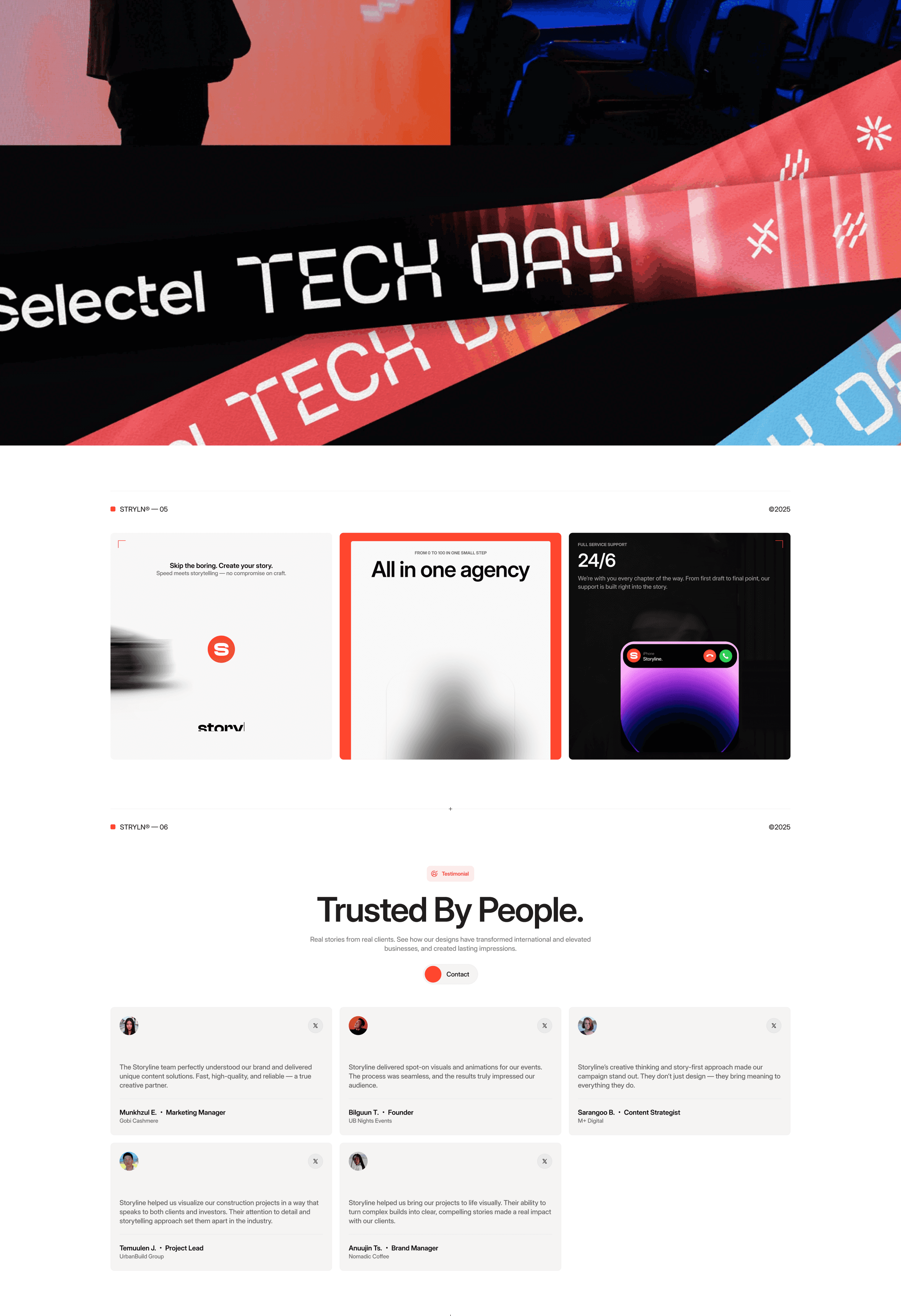
Numbered sections as spine. Every section is tagged STORYLINE — 01 through 09 in the margin. A small device, but it turns a long scroll into a document with structure, and it gives the page the feel of a studio's own system rather than a template.
Break the rhythm on purpose. Two full-bleed black interruptions — the 3D character with the hand-drawn VALLEY script, and the diagonal Selectel Tech Day banner — sit between the composed white sections. They function as breathing room and as evidence at once: the page stops arguing and just shows something.
Structure the rest around the sales conversation. Three services numbered and separated, client logos running as a marquee, testimonials, FAQ, contact. Standard agency architecture, deliberately — the unusual work happens in the project presentation and the interruptions, and the conversion path underneath stays legible.


Outcome
Designed and built. Then the client went quiet.
The site is complete and functional, but it never got its real content — the blog posts are still placeholders, the About and Work pages were never filled, and it sits on a test subdomain rather than a domain of their own. Everything structural works; nothing was ever switched on.

What I Learned
Content is a dependency, not a follow-up. I built every section assuming the copy, stats, and case studies would arrive, and when they didn't there was no version of the site that worked without them. I'd now scope the content requirements as a deliverable with a date, not an open item.
A design that needs the client to finish it is an unfinished design. The structure holds up, but structure alone doesn't launch a site — and a page with test data on it is worth the same as no page.
Momentum is part of the job. The gap between "built" and "live" was a handful of emails, and I treated chasing them as outside my scope. Next time I'd rather over-involve myself in the last ten percent than deliver something that stalls at the door.
Back
Storyline — Event, marketing & content studio
Full site design and Framer build on the studio's existing brand. Structure, motion, and art direction end to end.
Role
Design & Build
Industry
Creative agency
status
Built
Year
2025
Challenge
Storyline produces large-scale events, marketing, and content for major Mongolian companies. Their credibility rests entirely on the scale and polish of that work — and they were sending prospective clients to a third-party Behance page to see it.
A Behance grid flattens everything. Every project becomes the same tile at the same size with the same chrome around it, and the agency has no control over what sits next to their work or what the page says about them. For a studio selling production quality, borrowed presentation is the wrong argument.
The constraint: their brand identity already existed and wasn't mine to change. Everything downstream of it was — structure, layout, typography in application, motion, art direction.
Process
Give the work full weight. Featured Projects runs four tiles at large scale, each carrying its own art direction rather than a uniform treatment — the acid-green Stargazing panel, the reversed red concert type, the cream Éclat Weddings serif, the monochrome Nexus Architecture frame. On Behance those four would have looked like one grid. Here they look like four different jobs, which is the actual claim the agency needs to make.
Numbered sections as spine. Every section is tagged STORYLINE — 01 through 09 in the margin. A small device, but it turns a long scroll into a document with structure, and it gives the page the feel of a studio's own system rather than a template.
Break the rhythm on purpose. Two full-bleed black interruptions — the 3D character with the hand-drawn VALLEY script, and the diagonal Selectel Tech Day banner — sit between the composed white sections. They function as breathing room and as evidence at once: the page stops arguing and just shows something.
Structure the rest around the sales conversation. Three services numbered and separated, client logos running as a marquee, testimonials, FAQ, contact. Standard agency architecture, deliberately — the unusual work happens in the project presentation and the interruptions, and the conversion path underneath stays legible.
Outcome
Designed and built. Then the client went quiet.
The site is complete and functional, but it never got its real content — the blog posts are still placeholders, the About and Work pages were never filled, and it sits on a test subdomain rather than a domain of their own. Everything structural works; nothing was ever switched on.
What I Learned
Content is a dependency, not a follow-up. I built every section assuming the copy, stats, and case studies would arrive, and when they didn't there was no version of the site that worked without them. I'd now scope the content requirements as a deliverable with a date, not an open item.
A design that needs the client to finish it is an unfinished design. The structure holds up, but structure alone doesn't launch a site — and a page with test data on it is worth the same as no page.
Momentum is part of the job. The gap between "built" and "live" was a handful of emails, and I treated chasing them as outside my scope. Next time I'd rather over-involve myself in the last ten percent than deliver something that stalls at the door.