Back
Back
MongolNFT × Sandbox — Meta Ulaanbaatar
A time-layered voxel city where futuristic and present-day Ulaanbaatar trade places mid-game. Campaign design and the Game Maker Fund application Sandbox approved.
Role
Concept & Design
Industry
Gaming · Web3
status
Launched
Year
2022

Challenge
MongolNFT owned 3×3 LAND on The Sandbox — 288×288 metres of voxel space — and a decision to make about what to put on it. Most branded metaverse land at the time was a showroom: a building, a logo, some avatars, nothing to do.
The harder version of the problem was cultural. Ulaanbaatar has been at least four different cities — a monastic settlement founded in 1639, a Soviet-era reformation project, the capital as it stands now, and whatever it becomes next. A single snapshot picks one and loses the rest.
Then a constraint arrived from the platform: The Sandbox required the 3×3 be reformed into a 2×2 plus two smaller parcels. The plan had to survive being cut apart.
Process
The city is shaped like a ger. The outline of the traditional Mongolian home became the footprint of the whole build — the one decision everything else sits inside, and the reason the land reads as Mongolian before a single asset loads.
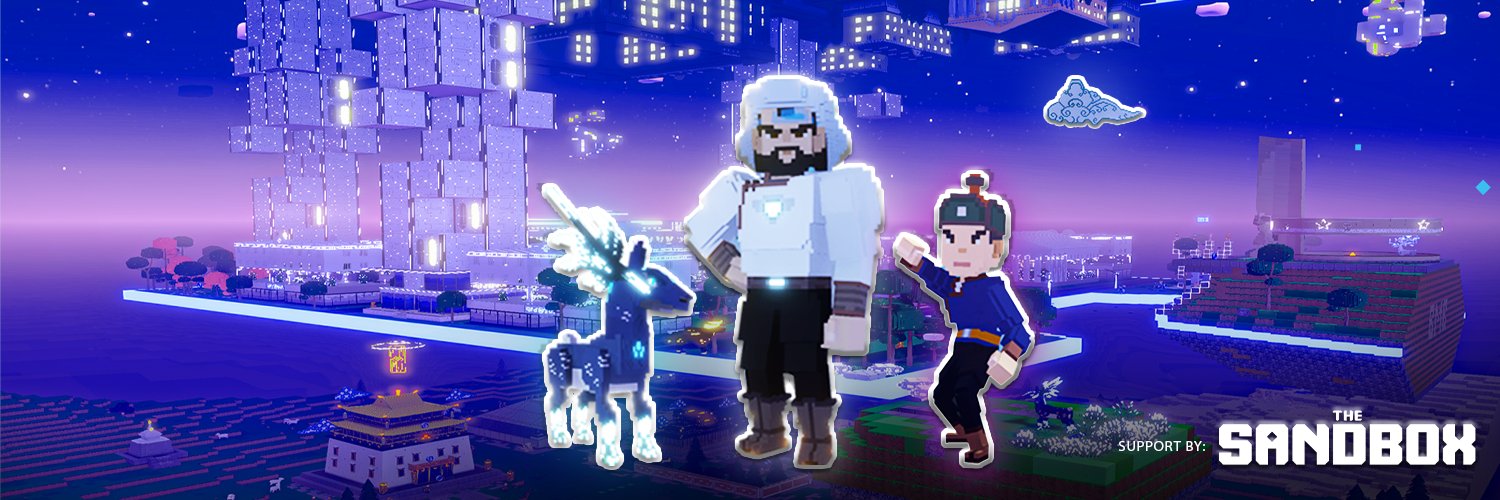
Stack the eras instead of choosing one. Beneath sits Khuree City, Ulaanbaatar under the Bogd Khan, rendered in cyberpunk — four mountain ranges, the palace, Gandan monastery, and open ground kept clear for Naadam. Above it, the City of Creators: present-day street planning with the parliament building and Chinggis Square, drawn futuristic. Two more historical layers, the 1960s reformation era and the 9th–11th century ruins of Хар Бухын Балгас, sit on the smaller parcels as single-player maps.
The swap is the whole idea. Futuristic Ulaanbaatar stands upright; present-day Ulaanbaatar hangs inverted directly above it. At points during play the two dissolve and trade places, so a player standing in the future watches the present descend around them. That's the multiverse effect the project is named for, and it carries the argument without a line of text: what gets built now becomes what's underneath later.
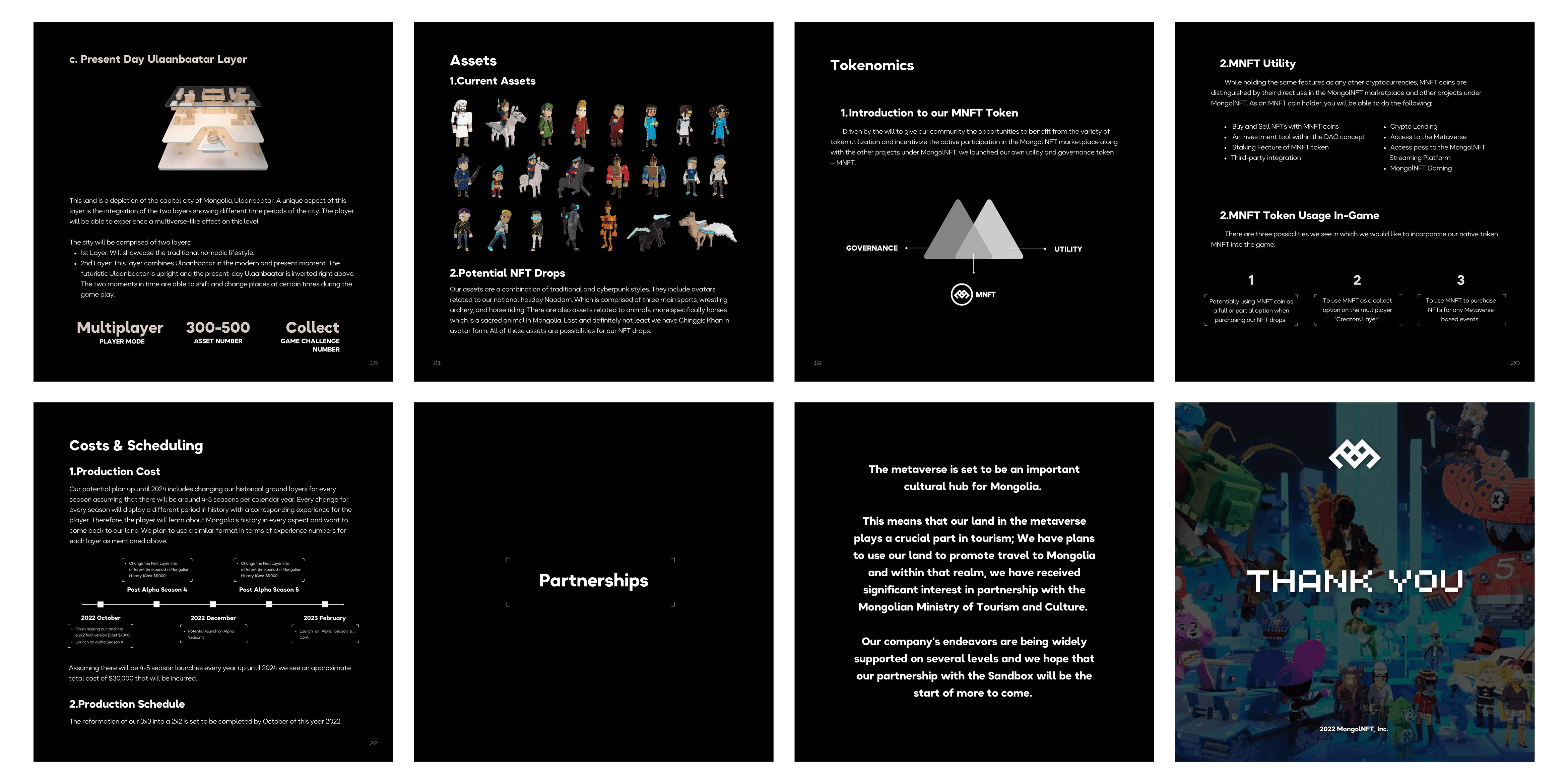
The land split became the structure, not a compromise. The 2×2 holds the multiplayer city; the 1×3 and 1×2 carry single-player historical maps that rotate each Alpha Season, so a different period of Mongolian history surfaces every few months. The platform's constraint turned into the content model.

Outcome
The Sandbox approved the Game Maker Fund application, and the city was built and launched.
The concept was tested publicly before it was built. MongolNFT opened a national competition in December 2021 asking people to envision Ulaanbaatar in The Sandbox — 113 teams entered, competing for ₮100M (~$35,000), with winners announced at an event in February 2022. I designed the campaign that ran it.
MongolNFT put roughly $211,000 into the land and its development. The project also drew partnership interest from Mongolia's Ministry of Culture and Tourism, which reframed the land as a tourism asset rather than a marketing one.

What I Learned
The constraint was the best thing that happened to the project. Being forced to split the 3×3 into smaller parcels is what produced the seasonal rotation — I wouldn't have arrived at it on my own.
One spatial decision can carry an entire concept. The ger footprint did more work than every asset placed inside it.
In a medium where nobody reads, the idea has to be legible from movement alone. The swap communicates the whole argument without a word of text.
Back
MongolNFT × Sandbox — Meta Ulaanbaatar
A time-layered voxel city where futuristic and present-day Ulaanbaatar trade places mid-game. Campaign design and the Game Maker Fund application Sandbox approved.
Role
Concept & Design
Industry
Gaming · Web3
status
Launched
Year
2022
Challenge
MongolNFT owned 3×3 LAND on The Sandbox — 288×288 metres of voxel space — and a decision to make about what to put on it. Most branded metaverse land at the time was a showroom: a building, a logo, some avatars, nothing to do.
The harder version of the problem was cultural. Ulaanbaatar has been at least four different cities — a monastic settlement founded in 1639, a Soviet-era reformation project, the capital as it stands now, and whatever it becomes next. A single snapshot picks one and loses the rest.
Then a constraint arrived from the platform: The Sandbox required the 3×3 be reformed into a 2×2 plus two smaller parcels. The plan had to survive being cut apart.
Process
The city is shaped like a ger. The outline of the traditional Mongolian home became the footprint of the whole build — the one decision everything else sits inside, and the reason the land reads as Mongolian before a single asset loads.
Stack the eras instead of choosing one. Beneath sits Khuree City, Ulaanbaatar under the Bogd Khan, rendered in cyberpunk — four mountain ranges, the palace, Gandan monastery, and open ground kept clear for Naadam. Above it, the City of Creators: present-day street planning with the parliament building and Chinggis Square, drawn futuristic. Two more historical layers, the 1960s reformation era and the 9th–11th century ruins of Хар Бухын Балгас, sit on the smaller parcels as single-player maps.
The swap is the whole idea. Futuristic Ulaanbaatar stands upright; present-day Ulaanbaatar hangs inverted directly above it. At points during play the two dissolve and trade places, so a player standing in the future watches the present descend around them. That's the multiverse effect the project is named for, and it carries the argument without a line of text: what gets built now becomes what's underneath later.
The land split became the structure, not a compromise. The 2×2 holds the multiplayer city; the 1×3 and 1×2 carry single-player historical maps that rotate each Alpha Season, so a different period of Mongolian history surfaces every few months. The platform's constraint turned into the content model.
Outcome
The Sandbox approved the Game Maker Fund application, and the city was built and launched.
The concept was tested publicly before it was built. MongolNFT opened a national competition in December 2021 asking people to envision Ulaanbaatar in The Sandbox — 113 teams entered, competing for ₮100M (~$35,000), with winners announced at an event in February 2022. I designed the campaign that ran it.
MongolNFT put roughly $211,000 into the land and its development. The project also drew partnership interest from Mongolia's Ministry of Culture and Tourism, which reframed the land as a tourism asset rather than a marketing one.
What I Learned
The constraint was the best thing that happened to the project. Being forced to split the 3×3 into smaller parcels is what produced the seasonal rotation — I wouldn't have arrived at it on my own.
One spatial decision can carry an entire concept. The ger footprint did more work than every asset placed inside it.
In a medium where nobody reads, the idea has to be legible from movement alone. The swap communicates the whole argument without a word of text.